It is very important that the language in your novel reflects the time and place in which the story is set.
For example, my story is set in Italy. My characters would never “ride shotgun”, a term coined in US in the early 1900s referring to riding alongside the driver with a shotgun to gun bandits.
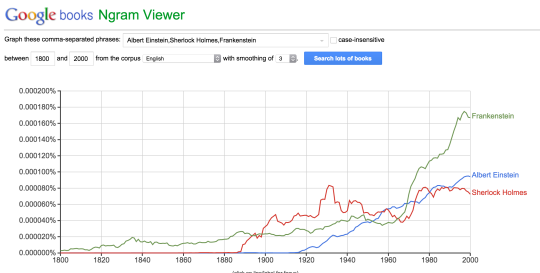
Do your research! A free tool that I found to be very useful is Ngram Viewer.
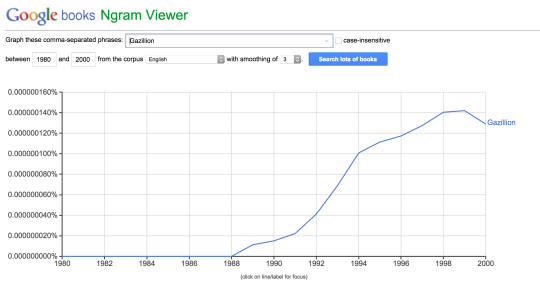
You can type any word and see when it started appearing in books. For example…one of my characters was going to say “gazillion” (I write YA) in 1994. Was “gazillion” used back then?
And the answer is…YES! It started trending in 1988 and was quite popular in 1994.
Enjoy ^_^
This is really important, especially because language can change in very unexpected ways.
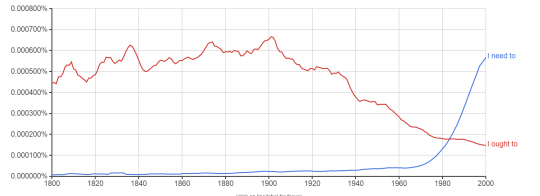
For example, did you know that before 1986 people never said “I need to”?Instead, they were far more likely to say “I ought to”, “I have to”, “I must”, or “I should”.
Don’t believe me?
Anyway, most people won’t notice subtle changes like that. But your reader will notice and be confused when characters in your medieval world use metaphors involving railroads and rockets.
One of the things you can do besides use Google Ngrams is to read books or watch movies written in the time period you want to set your story. The key here is that they can’t just be set in that time period, they have to have been made in that time period.
Also, there’s a Lexicon Valley episode on this very topic which I highly recommend. It’s called Capturing the Past.
Wait, are you Soupnazi21 on AO3 (I’m so hopelessly bad at keeping track of people’s IDs on different sites), or have I actually turned TWO people onto that song?
Either way, thank you so much. I was playing it on repeat as I wrote much of this chapter, trying to capture the feeling of that song in my writing, and make sure we had completely overwritten the jealousy and angst of the beginning chapters of the story. I’m so glad you liked the story, AND the song. I’m sort of thrilled some new people might actually appreciate David Poe, now. If you want to explore, some of my other favorites by him are “Reunion” (hysterical and a bit dark if you listen for it), “Apartment”, “Love is Red”, “Not Enough Night”, “Blue Glass Falls” (angry break up song), “Doxology”, and “These are the Days” and that’s just off the top of my head…
Oh, and a funny story about “Honey Moon.” I’m on David’s mailing list, and got a signed copy of the album before it was released. And he and I have met and occasionally email each other about where he’s touring, etc… he’s actually written me about advice on cover artwork before, just surveying a few fans. Anyway, I was so excited to hear his new album “God and the Girl” that I just immediately put it in my computer to get it loaded into iTunes. And I started playing before it had finished ripping. So Honey Moon started playing (because it’s first on the album), but then instead of playing the next song on God and the Girl, my computer just picks another random David Poe song from the (extensive) library, and it chose “The Settlement”, which is about a divorce.
I thought this was hysterical (obviously), and wrote to David to tell him what happened, and that it felt like he’d written this very abbreviated, REALLY sad story. He wrote back tickled, saying even HE would write something that sad, and then apparently told a bunch of his friends. He hadn’t ever considered pairing those songs but acknowledged that the effect was pretty devastating.
He’s enormously talented and pretty much broke, so please buy his music if you like it.
“May we all live as long as we like, may we all be as strong as the wine”
And thanks so much about your comments on Cleaving. I just had someone ask me for the address, I think because you’ve been reblogging my teasers.
Last night I started doing the research I needed for the epilogue… so I’m trying to keep the momentum up…
I just realized that Cleaving (60k words) is almost as long as Bleary (63k words), and might be as long, once the epilogue is written)… No wonder it took me fucking forever.
Zach turns forty and his world changes. Or, maybe, it circles back to where it was always meant to be.
*
Zach spots him as soon as he steps in the cafe; sitting with his back to the wall, a mug of coffee that Zach knows has been refilled at least twice by the way Chris’ leg is slightly jittery, and a moleskine on the table, hand moving in a steady rhythm as he scribbles something down.
“Hi,” Zach says once he’s by the table, casting a shadow over Chris. He tries not to think about the symbolism in that.


 Ato's Fandom Blog