you know whats wayyyyy easier than writing? scrolling through tumblr for hours and hours and tangentially thinking about your WIPs but not Actually working on them
writer: *stops mid-sentence* damn what’s the word I want?
writer: *spends 25 minutes on google trying to figure out the right vocab word*
writer: *gets a paragraph done*
writer: *starts another sentence, stops* what is that really specific fact I need?
writer: *spends an hour trying to figure out this obscure thing that probably doesn’t actually matter*
writer: Wait what’s that thing called again?
writer: *has no idea how to search for what I need*
writer: *ends up digging through blogs and other archived websites for details*
writer: *needs to reference source material for fact checking*
writer: *has to eat and sleep at some point*
writer: should it be “she regards him with disdain” or “she glares at him with disdain” ??? (hint: it doesnt matter but gunna go back and forth over it for an hour)
writer: *gets distracted by the internet in general*
writer: HOW IS THIS ONLY 800 WORDS???????
writer: fuck proofreading
writer: okay fine i’ll proofread.
writer: holy shit this is awful.
writer: *reworks entire sections*
writer: *doesn’t think I’m good enough as a writer and stops for a few days*
writer: repeat process as needed.
It is very important that the language in your novel reflects the time and place in which the story is set.
For example, my story is set in Italy. My characters would never “ride shotgun”, a term coined in US in the early 1900s referring to riding alongside the driver with a shotgun to gun bandits.
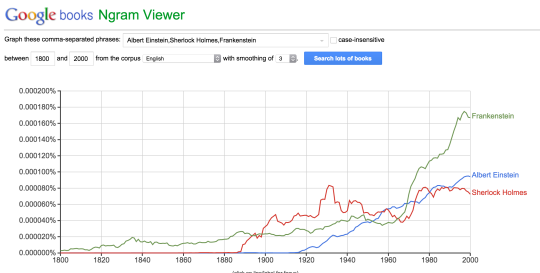
Do your research! A free tool that I found to be very useful is Ngram Viewer.
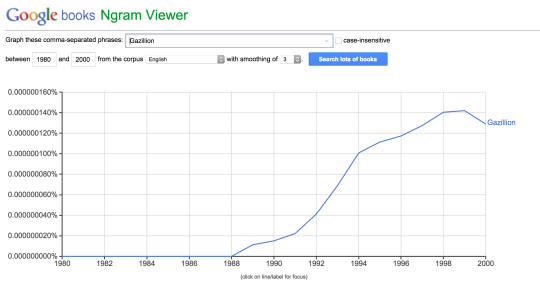
You can type any word and see when it started appearing in books. For example…one of my characters was going to say “gazillion” (I write YA) in 1994. Was “gazillion” used back then?
And the answer is…YES! It started trending in 1988 and was quite popular in 1994.
Enjoy ^_^
This is really important, especially because language can change in very unexpected ways.
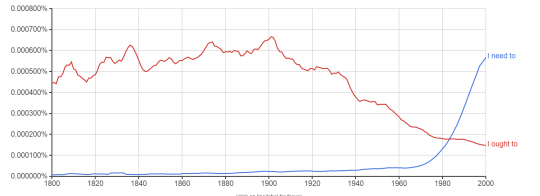
For example, did you know that before 1986 people never said “I need to”?Instead, they were far more likely to say “I ought to”, “I have to”, “I must”, or “I should”.
Don’t believe me?
Anyway, most people won’t notice subtle changes like that. But your reader will notice and be confused when characters in your medieval world use metaphors involving railroads and rockets.
One of the things you can do besides use Google Ngrams is to read books or watch movies written in the time period you want to set your story. The key here is that they can’t just be set in that time period, they have to have been made in that time period.
Also, there’s a Lexicon Valley episode on this very topic which I highly recommend. It’s called Capturing the Past.
SEE ALSO Etymonline. Word origins and when they’re first recorded. So, say I wanted to find out when a “coffee break” became a thing – around the 1950s, as seen in magazine adverts – or characters might talk about more genrallly “taking a break” from the 1860s…
• Had a character fling their trousers or skirt against the wall in the throes of passion- only to realise they never lost their shoes
• Found themselves grazing every reference work under the sun and gave up realising lips have no synonyms
• Frozen in front of their screen, feeling like a shy virgin
• Wrecked their heads trying to find that perfect balance between daring and crude
• Embarrassed the other sex asking by them questions for research
• Been hesitant to start on a piece, worried that it’ll read exactly like their other ones
• Lost overview of what positions their characters are in and where all those limbs are at
• Awkwardly googled a position or practice they have no personal experience with
• Been afraid to hit the post button for fear that nobody else will find their fantasies appealing
Erotica is just as challenging to write as any other type of story.
Don’t ever let anyone tell you otherwise. Don’t ever allow yourselves to be condescended upon.
Know what hard work you do. Know all erotica writers have struggled with these issues. Know the skills you’ve had to acquire. Know your works are worth just as much as plot-driven ones.
when people point out a scene/particular line(s) that tugged at their heartstrings
when people ask for your meta of your work that they enjoyed so much
when someone comments on a fic you wrote 982783113502 years ago
getting recc’d
just the small happiness in knowing you made someone out there smile on their way to work/home or at school, in knowing you warmed someone’s heart somehow

 Ato's Fandom Blog